
Does reflective insulation really work?
Published on 27.09.2026 · Isoflect Insulation technical team
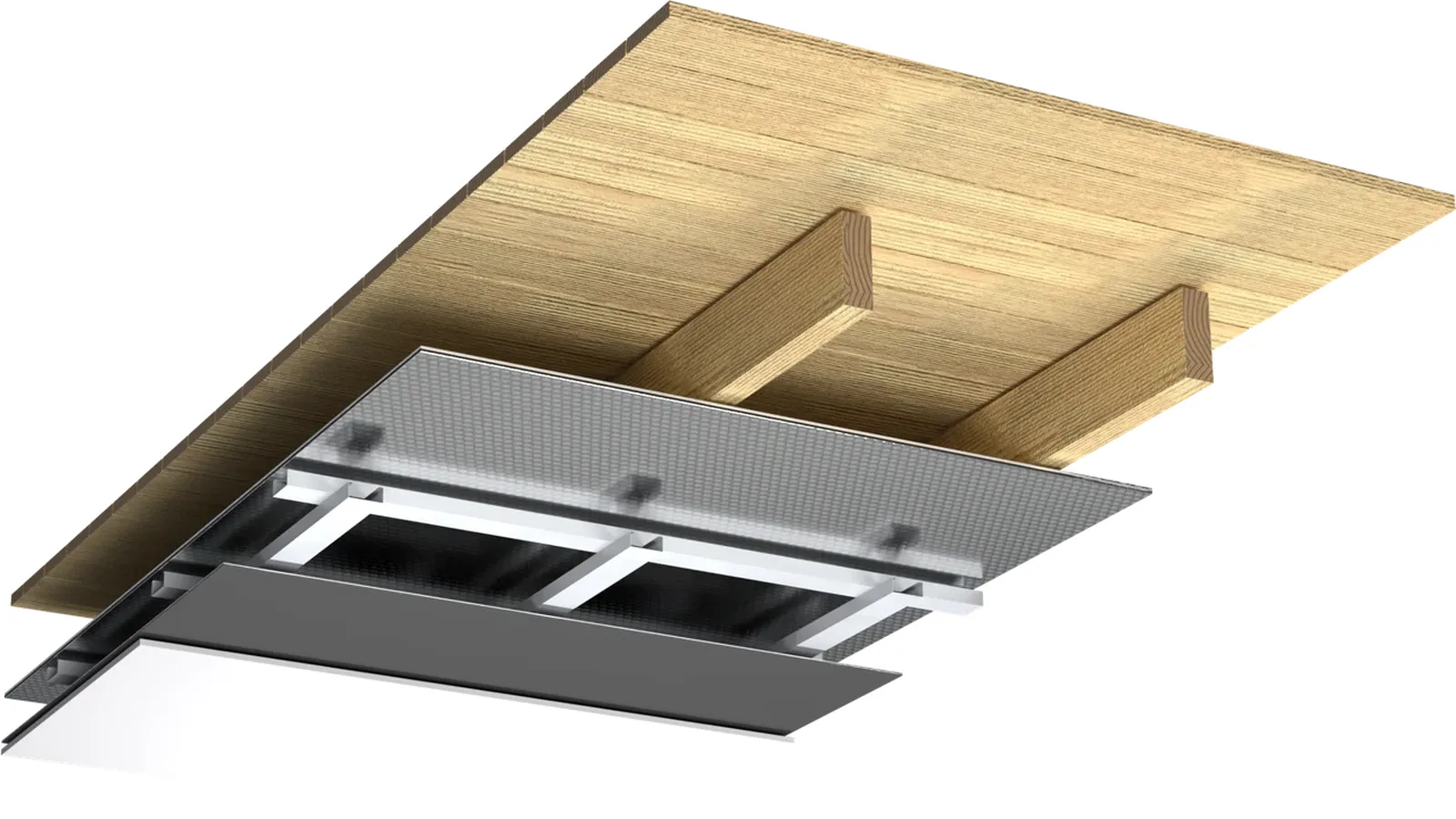
A reflective membrane installed beneath the roof does not, on its own, turn a habitable attic into an energy-efficient space. However, reflective insulation works very well when it is selected for the correct role and installed as part of a complete system: with an air space, careful sealing and thermal and acoustic insulation adapted to the structure.
The confusion arises because this type of material is sometimes presented as a universal alternative to thick layers of mineral wool or ecological fibre. In reality, its mechanism is different. A reflective membrane reduces heat transfer by radiation, whereas fibrous materials reduce transfer by conduction and convection. In a high-performance construction, the two technologies complement each other.
How reflective insulation works
Heat is transferred through three mechanisms: conduction, convection and radiation. Conduction occurs when heat passes through a solid material, convection through the movement of air, and radiation through the emission of thermal energy between surfaces. The metallised surfaces of a reflective membrane have low emissivity and therefore reflect a large proportion of thermal radiation.
This effect is particularly useful beneath the roof covering. In summer, a large proportion of the energy absorbed by metal sheeting, tiles or roof boarding is radiated towards the interior of the habitable attic. In winter, the warm interior surfaces radiate energy towards the colder areas of the roof. The reflective membrane can limit these exchanges, contributing to a more stable temperature within the construction layer.
In order to reflect radiation, the aluminised face requires an adjacent air cavity. If the material is bonded directly to timber, plasterboard or wool, the reflective effect decreases considerably. The membrane remains useful for other functions, such as vapour control or sealing, but no longer provides the same radiant thermal contribution.
Does reflective insulation only work with an air space?
Yes, as far as the reflective component is concerned, the air space is essential. As a rule, it is obtained by installation on battens or counter-battens, so that an air cavity exists between the membrane and the finish or between the membrane and another layer. The exact dimension must be coordinated with the system, the construction detail and the product instructions, not chosen at random.
Another decisive detail is the orientation of the reflective face. It must face the air cavity from which the radiation to be controlled originates. In a habitable attic, the correct position depends on the complete build-up: roof covering, diffusion layer, ventilation, thermal insulation between the rafters, interior membrane and cladding.
The cavity must not be confused with a zone through which uncontrolled air circulates. An air cavity that is sealed or correctly ventilated according to its position in the roof is one thing; infiltration through overlaps, perforations and joints is another. Air entering in an uncontrolled manner can carry moisture into the structure and can reduce thermal comfort.
What a reflective membrane can do within a complete system
Depending on the product, a reflective membrane may perform several functions simultaneously. This is one of the relevant differences between a thin membrane chosen solely on the basis of appearance and a solution designed for construction. It can contribute to limiting thermal radiation, to sealing the interior layer, to controlling vapour diffusion and, in certain build-ups, to reducing the risk of interstitial condensation.
Nevertheless, terminology matters. A vapour barrier, a vapour retarder and a diffusion membrane are not interchangeable. A vapour barrier very strongly limits the passage of vapour from the interior towards the cold layers. A vapour retarder permits a controlled transfer. A diffusion membrane is generally installed on the exterior side of the thermal insulation and allows vapour to escape, while at the same time protecting against water and draughts.
The choice is made according to the position of the layer in the wall or roof, the type of insulation, the local climate, the ventilation of the space and the capacity of the structure to dry out. A membrane with a vapour barrier function incorrectly installed on the cold side may trap moisture where it cannot evaporate. The result may be condensation, damp timber and costly remedial work after a few years.
Why it does not replace thermal insulation wool
A reflective membrane is thin. On its own, it cannot provide the same resistance to heat transfer as a correctly dimensioned layer of mineral wool, wood fibre, cellulose or ecological wool. If the objective is to reduce heat losses through a roof, the thickness and thermal conductivity (lambda) of the main insulation layer remain decisive.
In a habitable attic, for example, the thermal insulation between and below the rafters reduces heat conduction. The reflective membrane, installed towards the interior and correctly sealed, completes the system by controlling radiation and vapour. If a service cavity is provided between the membrane and the plasterboard cladding, it facilitates electrical routing without repeated perforation of the airtight layer.
The same logic applies to lightweight construction, timber-frame walls and attics converted into usable spaces. Reliable and predictable performance is achieved when each layer has a clear function, not when a single product is required to solve all of the building's problems.
Installation makes the difference between performance and marketing
A premium membrane loses much of its value if the joints remain unsealed. Water vapour and warm air do not need a large hole to reach the cold layer. They pass through fine gaps, around cables, at junctions with walls, around roof windows and at incompletely bonded overlaps.
Correct installation requires continuity. Overlaps are sealed with compatible tape, and areas of contact with masonry, timber or metal elements are dealt with using tapes and adhesives appropriate to the substrate. Penetrations for cables, pipes or spotlights require sleeves or sealing details, not merely tape applied in haste.
It is equally important to protect the membrane from unnecessary perforation. A service cavity installed on battens allows finishes to be fixed and cables to be installed with a much lower risk to the air and vapour barrier. For a complex roof, with chimneys, dormers, windows or numerous services, this detail can make the difference between a safe system and a vulnerable one.
When the investment is worthwhile
Reflective insulation is a sound choice for habitable attics beneath a roof covering exposed to the sun, unheated attics, lightweight-frame construction, selected interior walls and areas where sealing and vapour control are required. It is particularly valuable when the available space is limited and each layer must perform several functions.
It is not the appropriate solution if purchased with the expectation of entirely replacing bulk thermal insulation. It does not compensate for the lack of ventilation beneath the roof covering, for thermal bridges created by the rafters or for air infiltration at junctions. Likewise, an interior membrane does not resolve a water problem originating from a damaged roof covering.
For a sound decision, start from the installation area and the existing build-up. Establish what must be controlled as a priority: summer overheating, winter losses, condensation, noise, vapour or all of these together. Then choose a package of compatible layers, with the insulation thickness calculated for the project and sealing accessories included.
A technical check before installation costs far less than dismantling a finish after condensation has appeared. For habitable attics, unheated attics and renovations with unclear details, the consultancy offered by Isoflect can help configure a system adapted to the actual structure, not merely to a promise on the packaging.
Complete comfort does not come from a membrane placed beneath the roof, but from layers that work together: correctly dimensioned insulation, air and vapour control, carefully designed cavities and precise installation. That is where a more efficient, drier and more comfortable home begins.